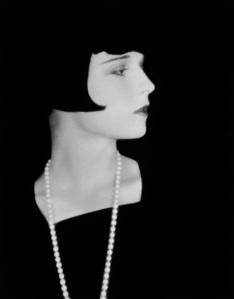
I finished this book disappointed to an extent. I have been a huge fan of Louise Brooks and upon hearing of the book I was excited.
To be fair, the book is good. There are some good characterizations and some (shocking) revelations. However, I was left unconvinced of the main protagonist; she just wasn't interesting enough for me.
From the moment Louise Brooks enters, however, the page the story takes on a whole new dimension. Here is someone who is determined, ambitious, challenging, engaging - alive!
The setting is 1922 and Moriarty sets the scene spectacularly, introducing the various characters and the places and situations well. There are some tense scenes that make gripping reading.
The scenes involving Brooks are quite amazing and its through her interactions with Brooks that the main character Cora, comes to life.Cora's background and reasons for acting as chaperone are slowly revealed and you do get a sense of someone who could be interesting but remains passive throughout the majority of the novel.
I felt that once both parties went their separate ways then the story could have wrapped up - but it didn't.
Once Louise is out of the picture we are left with Cora to see us through til the end. Cora herself is not unlikable, she's just too dull.
The story itself is basically a journey of self discovery, whereby Cora finds out more about herself through her time with Louise and returns home to Kansas a different woman. A good, solid plot that worked well but went on a little too long and took away the magic for me.
But if you are a fan of Louise Brooks then I would recommend this as it captures much of Brooks' strong personality through good writing.
Showing posts with label icon. Show all posts
Saturday, 9 January 2016
Thursday, 23 October 2014
Blood Well Spent: Anne Boleyn's Triumph
There is a classic scene in Anne of the Thousand Days (Jarrott, 1969) where Anne Boleyn (Genevieve Bujold) looks Henry VIII (Richard Burton) in the eye and proclaims 'My Elizabeth shall be queen! And my blood will have been well spent!'
There is no proof that such an exchange ever took place between the pair but it is a powerful and prophetic moment that tells the viewer that Anne's blood was indeed well spent, and her words prove true as Elizabeth, her daughter, became possibly the greatest ruler England ever had. How she eventually came to be queen is nothing short of a miracle, the 'bastard' daughter of King Henry VIII, who became renowned as the Virgin Queen.
Elizabeth was the daughter of King Henry VIII, infamous for his six wives and establishing the Church of England. A church established in order to divorce his first wife Katherine of Aragon so that he could then marry his second wife, Anne Boleyn.
Anne won Henry's heart through her passionate personality and her many refusals of being his mistress. Once married it wasn't long before Anne was pregnant. Unfortunately, she did not deliver the son Henry so desperately wanted but a girl who she named Elizabeth. After this Anne failed to produce another living child and was eventually disgraced and executed on charges of adultery, witchcraft and treason on 19th May 1536. Elizabeth was only two years old.
Henry married a further four times and did manage to have the son he desired with his third wife Jane Seymour, and Elizabeth was overlooked for the majority of her young life in favour of her brother. However, she was eventually restored to the succession with help from Henry's sixth wife, Katherine Parr, who took a kinder incentive towards Elizabeth, providing for her education and establishing her own belief in the Protestant faith. Katherine had even been left as regent of the kingdom when Henry went to war with France, showing Elizabeth that it was possible for a woman to rule in her own right.
When Henry died in January 1547 Elizabeth went to live with her stepmother and her fourth husband Thomas Seymour. During this time there is much speculation about the conduct of Seymour in his affection towards his ward, attempting to seduce her and besmirching her honour. Eventually she was established in her own household and never saw Katherine Parr again. During her brother's reign, Edward VI, she lived quietly but was under suspicion when Seymour devised a plot to kidnap the king, for which she was found innocent.
Edward died in July 1553, which made her sister, Mary Tudor, Queen of England - the first Sovereign Queen in England's history. When Mary entered the city of London Elizabeth was with her, following her sister who triumphed over rebellions to prevent her ascension to the throne. Mary's reign began with a positive outlook, even with the sisters looking to heal old wounds. Unfortunately this did not last. After time questions of religion plagued Mary's reign, and completely destroyed any relationship the sisters once had when Elizabeth was placed in the tower and rigorously questioned in connection with rebellions by Thomas Wyatt, accusations which again had no basis of proof. The relationship between them never recovered and Mary died alone in 1558, defeated and loathed by the people.
Upon her death Elizabeth became the Queen of England. Her reign began with much upheaval and religious persecution that was eventually outlawed, with Elizabeth being more accepting of both Catholic and Protestant faiths, unlike her siblings. Over time Elizabeth established England as a powerful nation in its own right, her reign remembered as a golden age in English history. Elizabeth never married or produced an heir to carry on the Tudor name, she became known as The Virgin Queen; an icon and a mother to her people. England prospered under her rule, which is why she is admired to this day. Even in the face of adversity she proved her mettle; such as the Spanish Inquisition that looked to 'cleanse' England of heresy, an invasion that was unsuccessful despite the odds being in Spain's favour. Elizabeth I is remembered by many names - Good Queen Bess, Gloriana, The Virgin Queen. She overcame the odds to become the best loved of the Tudor Sovereigns.
Elizabeth became Anne's greatest triumph. As the prophetic and poignant scene proves, Anne's blood was indeed well spent.
![]() |
| Blood well spent: Anne of the Thousand Days |
Elizabeth was the daughter of King Henry VIII, infamous for his six wives and establishing the Church of England. A church established in order to divorce his first wife Katherine of Aragon so that he could then marry his second wife, Anne Boleyn.
![]() |
| The Queen's Mother: Anne Boleyn |
Henry married a further four times and did manage to have the son he desired with his third wife Jane Seymour, and Elizabeth was overlooked for the majority of her young life in favour of her brother. However, she was eventually restored to the succession with help from Henry's sixth wife, Katherine Parr, who took a kinder incentive towards Elizabeth, providing for her education and establishing her own belief in the Protestant faith. Katherine had even been left as regent of the kingdom when Henry went to war with France, showing Elizabeth that it was possible for a woman to rule in her own right.
![]() |
| The Lady Elizabeth Tudor |
Edward died in July 1553, which made her sister, Mary Tudor, Queen of England - the first Sovereign Queen in England's history. When Mary entered the city of London Elizabeth was with her, following her sister who triumphed over rebellions to prevent her ascension to the throne. Mary's reign began with a positive outlook, even with the sisters looking to heal old wounds. Unfortunately this did not last. After time questions of religion plagued Mary's reign, and completely destroyed any relationship the sisters once had when Elizabeth was placed in the tower and rigorously questioned in connection with rebellions by Thomas Wyatt, accusations which again had no basis of proof. The relationship between them never recovered and Mary died alone in 1558, defeated and loathed by the people.
Upon her death Elizabeth became the Queen of England. Her reign began with much upheaval and religious persecution that was eventually outlawed, with Elizabeth being more accepting of both Catholic and Protestant faiths, unlike her siblings. Over time Elizabeth established England as a powerful nation in its own right, her reign remembered as a golden age in English history. Elizabeth never married or produced an heir to carry on the Tudor name, she became known as The Virgin Queen; an icon and a mother to her people. England prospered under her rule, which is why she is admired to this day. Even in the face of adversity she proved her mettle; such as the Spanish Inquisition that looked to 'cleanse' England of heresy, an invasion that was unsuccessful despite the odds being in Spain's favour. Elizabeth I is remembered by many names - Good Queen Bess, Gloriana, The Virgin Queen. She overcame the odds to become the best loved of the Tudor Sovereigns.
Elizabeth became Anne's greatest triumph. As the prophetic and poignant scene proves, Anne's blood was indeed well spent.
Saturday, 18 October 2014
Silent Seduction: There is only Louise Brooks
‘If I ever bore you, it’ll be with a knife’.
These words were uttered by Louise Brooks. And they‘re true. If you dig deep enough into her life, you’re likely to be fascinated by the elusive and sultry beauty who became the embodiment of 1920’s Hollywood. With her uniquely exotic good looks and her banged and bobbed hair style, Louise Brooks captivated moviegoers everywhere, yet critics and film executives alike were unimpressed with her acting abilities. As the years went by, however, Brooks has become a cult icon whose work is seen as a remarkable accomplishment in cinema history.
Mary Louise Brooks was born on November 14, 1906 in Cherryvale, Kansas to Leonard and Myra Brooks, the second of four children. When Louise was four years old she starred in a church benefit production of Tom Thumb’s Wedding, portraying the bride. Her mother was impressed by the way her daughter ‘manipulated her shower bouquet and bridal veil with all the ease and assurance of a grownup bride’.
It was then in 1925 that Hollywood came calling and Brooks signed a five year movie deal with Paramount Pictures. After starring in her first picture, The Streets of Forgotten Men, Brooks quickly became leading lady material. After a couple of years in Hollywood, Brooks moved over to Berlin in 1928 where she filmed her most iconic role of Lulu, in G. W. Pabst’s Pandora’s Box(1928).
What makes Brooks’ performance in Pandora’s Box fascinating to watch is the way in which she connects sex and death in a way no other actress possibly could is a testament to her dexterity. The way she portrays Lulu as an innocent yet provocative entity through her own distinctive subtlety is extraordinary, Brooks herself later referring to her style as ‘the movement of thought and soul transmitted in a kind of intense isolation’. By the end of the movie Lulu herself has lost most of the innocence she once possessed at the beginning and is now isolated from society. Her downfall in the end comes when, on Christmas Eve, she prostitutes herself to Jack the Ripper. Brooks later described the scene as ‘It is Christmas Eve and she is about to receive the gift that has been her dream since childhood. Death by a sexual maniac.’
Pandora’s Box was a flop and Brooks received negative feedback for her performance. But she went on to film another Pabst production, Diary of a Lost Girl (1929), based on the book by Margerete Bhome. and one French film, Prix De Beaute (1930). After this Brooks decided to return to Hollywood. Pabst begged her to stay on in Europe but she refused. Of course, Pabst eventually became tired of her endless drinking and responded, ‘your life is exactly like Lulu’s and you will end the same way’.
Upon returning to Hollywood Brooks had become blacklisted due to her refusal to film sound retakes for The Canary Murder Case. In the years that followed she was reduced to bit parts in poorly produced films such as Windy Reilly in Hollywood. She also battled with excessive alcoholism which had become a problem while working in Berlin. She was eventually exiled from Hollywood and moved back to Kansas in 1940. Pabst’s prediction had become a reality.
After being forced out of Hollywood and living in Kansas, Brooks scrubbed floors for a living before moving to New York in the mid-forties where she went from working as a sales girl to working as a call girl before spiralling into a middle aged, overweight, alcoholic has-been. She was ultimately rescued from this despair by old flame William Paley, who became her benefactor by giving her a monthly allowance which she lived by for the rest of her days.
Virtually her whole life, Brooks had had problems with controlling her excessive behaviour. She struggled to gain the proper respect from many Hollywood executives; struggled with alcoholism for most of her life and garnered a reputation as a whore due to her many illicit affairs with both men and women. Brooks was a modern woman and just didn’t fit in with Hollywood’s customary clientele.
Maybe if her circumstances had been different she could have gained a long and successful career. However, Louise Brooks’ character had been irreparably altered, especially her sexuality, when she was molested by a neighbour at the age of nine. This traumatic event was the turning point in Brooks’ life that contributed to her complex, excessive and reclusive temperament. However horrific an effect this had on Brooks, it has to be said that if not for these qualities that she possessed she would possibly not have possessed such an alluring personality.
After spending twenty years living in isolation from the world, something incredible happened. In the mid-fifties she became acknowledged as an iconic presence of the silver screen for her work in Pandora’s Box. Finally, after years of self loathing and seeing herself as a fuck-up, Brooks’ stature in cinema history had finally become that of a monumental genius of acting and fashion, whose style is replicated by actresses throughout Hollywood to this day. Film historian and restorer, Henri Langlois once declared, ‘There is no Garbo, there is no Dietrich, there is only Louise Brooks’. This is true for fashion trends of late, with actresses and models sporting Brooks’ trademark banged and bobbed hair style, makeup and dress sense on runways and in magazines, as well as other stars from the 1920s and 30s.
With this new found respect, Brooks built up an illustrious reputation as ‘the finest writer to ever emerge from Hollywood’, as described by Roger Ebert. She wrote several essays discussing her life and career in Hollywood, all of which can be found in her autobiography, Lulu in Hollywood. Brooks had managed to turn her life around by taking her own failures and exploiting them to her full advantage. She had found that the love people had for her and her greatest creation, Lulu, would live and continue to grow after her death.
And it’s true. Today Louise Brooks has garnered something of a cult following, and her celebrity status is better known today than that of more successful silent actresses of her era, Mary Pickford, Gloria Swanson, amongst others. Thanks to her own subtle performance, Pandora’s Box is now seen as a masterpiece of world cinema. No other silent star oozed sex appeal in the same way while also displaying an unparalleled intelligence on the screen, and many historians and critics will agree, from Lottie Eisner to Kenneth Tynan.
In life, Brooks was seen as a talentless and destructive nymphomaniac. In death, she became the embodiment of 1920s sophistication. Many have paid homage to her through music, literature and film. She remains a fascinating creature and a true icon of the 20th century.
And like Miss Brooks herself said, ‘A well dressed woman, even though her purse is painfully empty, can conquer the world’.
Subscribe to:
Posts (Atom)