Tuesday, 24 May 2016

History vs Hollywood: Execution of Anne Boleyn

The Tudors are possibly the most famous royal family in British history. And they are consistently the subject of various dramatic works. Since the beginning of the 21st century alone there have been numerous TV serials and movies released, focusing on Henry VIII and his passion for the infamous Anne Boleyn, mother of Elizabeth I.

Here I will discuss the execution of Queen Anne and its portrayal in two very different drama series.

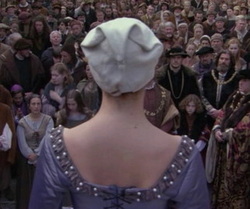
Wolf Hall: Anne Boleyn's final moments are played out through the eyes of Thomas Cromwell, the lead character of the series. We see her exit the tower and make her way to the scaffold, the whole time distracted and looking up towards the tower. She then makes her final speech and is subsequently beheaded.

The Tudors: The final moments of Anne Boleyn are told through her eyes, From her exit onto Tower Green through the throng of a large crowd to the scaffold where she makes her final speech and is subsequently beheaded.

Both series create a riveting scene that is memorable, but which one is more accurate?

The Facts:

Anne Boleyn is the most famous wife of Henry VIII. She gained the crown by supplanting Henry's first wife Catherine of Aragon and she gave him his daughter, Queen Elizabeth I.

Their love story is one of the most fascinating points in English history, a cornerstone that changed the direction of England forever. Henry disgarded his first wife, shunned his only legitimate daughter; brought down his most loyal minister; executed one of his closest friends and tore England away from the Catholic faith; all for the love of one woman.

The Fiction:

Her rise and fall has fascinated people for 500 years. In the wake of the 20th century came the media revolution. Over the next 110 years the exploits of Henry VIII and Anne Boleyn have been romanticized on screen, mostly as a tragic love story to entertain the masses.

Anne Boleyn's first on screen appearance was in 1911 in the short silent Henry VIII played by Laura Cowie who reprised her role in the 1914 short Anne Boleyn. After the German production of Anna Bolena (Lubitsch) in 1920 Anne remained a supporting character in films such as The Private Lives of Henry VIII (Korda, 1933) and A Man For All Seasons (1966).

One of the most celebrated films centering on the love story of Henry VIII and Anne Boleyn is Anne of the Thousand Days (Jarrott, 1969) starring Richard Burton and Gieneve Bujold, which chronicled their romance from its fiery beginning to its tragic end. After BBC's miniseries The Six wives of Henry VIII it was 37 years before a drama brought Anne Boleyn into the foreground in the same way as Anne of The Thousand Days.

A Modern Queen:

The Tudors (Hirst, 2007) first aired on the subscription channel Showtime and is the first in a long time to truly challenge the perception of Anne Boleyn and the factors behind her pursuit of Henry VIII. Actress Natalie Dormer played the iconic role of the Jezebel who bewitched a King; a woman who loved her husband so much it destroyed her. It's the first sympathetic portrayal that shows a multi-dimensional woman that is just as hard today to define in one category as it was 500 years ago. Dormer's performance is regarded as one of the greatest portrayals of Anne Boleyn in recent memory, leaving a hard act to follow.

January 2015 saw the BBC return to the story of Henry VIII, this time with Claire Foy as Anne Boleyn. Wolf Hall is based on the Pulitzer prize winning novel of the same name and its sequel Bring Up The Bodies by Hilary Mantel. It is told from the POV of Thomas Cromwell, one of Anne's strongest supporters and greatest enemies. Through this view the audience receive a very limited view of Anne Boleyn, a haughty and temperamental woman who's difficult for an audience to relate to.

Anne's Story:

Both series take very different approaches to the dramatization of the Tudors. Where The Tudors concentrates on the dramatic influence of events, often taking liberties with the timeline and period details, Wolf Hall expresses a strong emphasis on the historical facts above the drama, in the belief that the facts themselves are enough to entertain an audience.

With that in mind, both series take a very different take on Anne's final moments. It is certain that Wolf Hall wins in historical accuracy, showing the execution from an audience stand point, building up the tension as everyone waits for the final blow.

However, dramatically The Tudors gives a more emotionally charged scene, sympathizing with Anne as she lives out her final moments, making her way through a judgmental crowd towards the scaffold and giving her final speech, the camera offering a POV shot to give the viewer a glimpse of what Anne may have experienced in her final moments.

'I have come here to die': 

Overall, both series are well made and their creative differences both offer up scenes that are emotionally affecting. Despite the different POVs both scenes do follow the historical backdrop rather well. However, Wolf Hall does prove much more authentic. The execution itself with the executioner removing his shoes and Anne Boleyn having a blindfold over her eyes, to the accuracy of her final speech word for word. The Tudors alters the final speech slightly  and omits the blindfold, instead distracting Anne with 'Boy, fetch my sword'. As she turns she looks up to see birds flying away from the Tower. It's an effective scene that reinforces the image of Anne as a tragic heroine.

Where the BBC created a historically authentic costume piece, Showtime offered up a dramatic interpretation that modernized the story for a 21st century audience to relate to, which made the history easily accessible to those who didn't know anything about the Tudors to those who know and have a passion for their stories. This is where I feel that Wolf Hall falters slightly, because we see everything through Cromwell's eyes it changes the perception of Anne, making her less sympathetic, simplifying her character to that of a cold and arrogant person without much depth. I won't deny that these were aspects of her character but they were not the only traits she possessed. She believed in reform, desired to help unfortunate people and did much charity work, but Wolf Hall omits so much of Anne's various facets that it is hard to see how she managed to seduce the King of England with so little charm.

In the end, Wolf Hall does well with historical facts, but The Tudors succeeds in creating multi-dimensional characters for a modern audience. Therefore, Natalie Dormer's performance, for me, is by far the most affecting of the two portrayals, giving an opinionated, seductive, arrogant and at times sympathetic performance that stays with the viewer longer than Claire Foy's performance; though in her defense she worked with what she was given and did play the role well in Wolf Hall. But historically I think Dormer captured that complex nature of England's most infamous Queen.

Thursday, 3 March 2016

The Scandalous Lady W

Lady Seymour Worsley

In this day and age it is easy to take the freedoms we have for granted. Women have the right to vote, we can own property and it is no longer deemed shameful to remain unmarried and sexually active simultaneously (to most people). It's a far cry from the Georgian era when a woman was regarded as a man's property, without rights of their own. If a husband had an affair it was natural, if a woman had one she was shunned by society, not allowed to petition her case or even demand a divorce. That was the husband's privilege.

It's a frightening notion for any modern woman, but to a woman of the 18th century it was their lot in life. And it is a major aspect in the biography Lady Worsley's Whim by Hallie Rubenhold - later reissued as The Scandalous Lady W - who explores the complex and scandalous union of Sir Richard Worsley and his wife Seymour, who ran off with her husband's close friend Captain George Bissett. It resulted in Worsley suing Bissett for damages worth up to £20, 000 in compensation. A shocking sum even at that time.

Sir Richard Worsley, 7th Baronet
The aim of this was to humiliate and bankrupt Bissett while restoring Sir Worsley's honour as a victim. A huge miscalculation as Worsley didn't factor in his wife's hatred towards him, and considering their extracurricular activities it's easy to see why. It is not certain that Lady Worsley made the conscious decision to defend her lover by having her own character degraded but the defense was determined to prove to the whole country that Lady Worsley was not worth £20, 000. As a result the trial commenced with the Defense bringing to light the shocking truth: that Lady Seymour Worsley 'had been seriously compromised long before the captain made off with the spoiled goods'.

Of course this was a matter of Worsley's word against the gentlemen who came forward from Lord Deerhurst to her personal physician Dr William Osborn; for the alleged lovers the questioning ran along the lines of 'When did your first acquaintance commence with Lady Worsley?' and 'Did you frequently visit at Sir Richard's house?' As for the doctor, Osborn was not comfortable betraying his patient's confidence. 'My business was to cure her' was Osborn's answer, verifying he did not know how the Lady became ill but that he had never been called in regards to Sir Worsley's health at any given time. Again, not necessarily proving adultery or foul play in an explicit capacity.

Worsley's complicity within his wife's affairs was not proven until the statement of a bathing woman was read out in court, showing the extent of Worsley's duplicity. Rubenhold explains:

'Since birth [the priviledged classes] had been trained to be blind and dependent. When surveying the room they saw only the bodies of those who mattered. In most cases this excluded virtually everyone of a lesser social standing. As a result the privileged classes frequently forgot themselves in front of a theatre of labourers and staff, whose presence they failed to acknowledge'.

After the verdict Sir Richard Worsley
became the subject of ridicule.
Such was the case with Mary Marriot who held vital information that would make or break the case. Both sides sent their representatives down to interview the woman in question, an unimportant worker in the eyes of the privileged. But on that day she gave the damning evidence as follows:

'Lady Worsley used to come to the cold bath near Maidstone to bathe, and that she [Marriott] used to attend her; that Sir Richard and Mr Bissett were generally with her; and that the last time she came, which was about noon, in September last... Sir Richard tapped at the door, and said 'Seymour! Seymour! Bissett is going to get up to look at you'; and looking around she saw his face at the window... and that she did not see the plaintiff on the outside but believes he must help the defendant up'.

Such a declaration decided the case. The jury retired to consider their verdict. Upon their return they decreed that Sir Worsley was indeed entitled to compensation towards the dishonour he recieved from the plaintiff, and awarded him what they deemed appropiate: the total sum of one shilling.

BBC adaptation of Rubenhold's biography
It was a scandalous and entertaining case that was turned into a BBC film last year starring Natalie Dormer (The Tudors) which blended fact with fiction well enough, turning Lady Worsley into a heroine for the modern woman, blending the scandalous sexual proclivities of the Worsleys with the integrity of the courtroom. And Dormer proving her acting chops in her first leading performance after supporting on The Tudors, Game of Thrones and Casanova. Of course liberties were taken, with it being Seymour's idea to defame her name and appearing in the courtroom as her infidelities are exposed

As Rubenhold wrote, 'A married lady's character was a fragile thing'. Even after it was proven that her honour was depleted by her husband, Lady Worsley was still shunned by the respectable side of society while Sir Richard, due to his humiliation, fled to Europe, travelling through Greece and collecting various artifacts. But Seymour was left behind to deal with the judgements of her fellow socialites, running up large bills in her husband's name before eventually being exiled to France by Worsley himself who refused to grant her a divorce which led to the eventual split from George Bissett before her four year exile.

When Sir Richard died in 1805 Seymour married her lover Jean Louis Hummel, who was twenty one years her junior, who took his wife's name. She also regained the fortune that had been originally bequeathed to her over thirty years before. In the end Seymour enjoyed a quiet and happy life in her final years with her young husband.

Saturday, 9 January 2016

A Dead Good Read

I have to say I was surprised by how much I enjoyed this book. It was picked up in poundland one day and it proved to be a very entertaining read.

It centres on the friendship of Krissie and Sarah and shows the fractures of their fragile lives through their connection. Sarah wants a baby but can't, Krissie has one after a one night stand.

The author has written an interesting and entertaining book, with sparks of dark humour in the even the darkest moments. The characters are interesting, layered and flawed; their imperfections are what make them tick here and you are left curious as to how these two women have remained friends for so long despite their differing approaches to life; yet through that they need each other.

What is interesting is the psychological aspect of their personalities seeping through the pages; through their desires and their paranoia and fears. The book from one character's pov to another very well, usually connecting one's story with the other's; even highlighting someone's fragile state through the differing povs.

A surprisingly entertaining book, a perfect summer read that does keep you guessing and invest in the characters. Definitely worth a read.

The Chaperone by Laura Moriarty

I finished this book disappointed to an extent. I have been a huge fan of Louise Brooks and upon hearing of the book I was excited.

To be fair, the book is good. There are some good characterizations and some (shocking) revelations. However, I was left unconvinced of the main protagonist; she just wasn't interesting enough for me.

From the moment Louise Brooks enters, however, the page the story takes on a whole new dimension. Here is someone who is determined, ambitious, challenging, engaging - alive!

The setting is 1922 and Moriarty sets the scene spectacularly, introducing the various characters and the places and situations well. There are some tense scenes that make gripping reading.

The scenes involving Brooks are quite amazing and its through her interactions with Brooks that the main character Cora, comes to life.Cora's background and reasons for acting as chaperone are slowly revealed and you do get a sense of someone who could be interesting but remains passive throughout the majority of the novel.

I felt that once both parties went their separate ways then the story could have wrapped up - but it didn't.

Once Louise is out of the picture we are left with Cora to see us through til the end. Cora herself is not unlikable, she's just too dull.

The story itself is basically a journey of self discovery, whereby Cora finds out more about herself through her time with Louise and returns home to Kansas a different woman. A good, solid plot that worked well but went on a little too long and took away the magic for me.

But if you are a fan of Louise Brooks then I would recommend this as it captures much of Brooks' strong personality through good writing.

Kif: An Unvarnished War

This is the story of Kif. It's a story about his journey through the first World War and the effect it has on his life after it.

I read this due to my appreciation of Josephine Tey, writer of books such as The Daughter of Time and Brat Farrar, to name but two of her classic mysteries.

This is an altogether different book. This isn't a mystery, it's a tragedy that looks at the war through the eyes of a young boy who went from having a career and fighting for his country to being left out in the cold when they had no more need of him.

In many ways it is a great story, but in others it disappoints.

What disappoints most is the lack of sympathy I had with the main character through most of the book as he was a very unemotional individual with very few connections, but eventually that is how you do come to sympathize with him - an outsider trying to fit in.

The war itself is mentioned very little, it is told through incidents taking place around the war, while Kif is on leave or in confrontations with fellow soldiers. The first two acts drag on a little.

The third act is where things do get interesting.

Kif is left to fend for himself, manages to find work but it sadly comes undone in the end and he is forced into a life of crime as a means to survive. It is through this transition from naive boy to competent thief that we see the most change. It is through his treatment after the war, as a result of being turned down for employment due to a criminal record, of being stripped of hope for the future that Kif finally sets out on a criminal job that leads to his downfall.

It is the tragedy of Kif's story that is left with you at the end. A boy who fought for his country was left to fend for himself afterwards with no support from the Government in who's name he went to war for.Tey looks to get across to the reader that war was not glorious. It was harrowing and despairing; and for those who came home it was only part of the battle for survival.

Oz: The Dull & Lackluster


As a fan of the original 1939 classic The Wizard of Oz I admit I was intrigued to see the origin tale of Oz and all the characters we've come to know and love. Unfortunately, I was not left blown away by the movie. Essentially, the scenery appears to be the real star of the movie, with the characters added in to give a sense of nostalgia for the viewer.

In saying that, it isn't entirely a disaster; the film boasts a great amount of CGI that is stunning, but beyond the spectacle of Oz itself, it has nothing new to offer. My main issue is really with the characters within the story; I just didn't care about them. I know that Oz is supposed to be smug and narcissistic and then develop into the hero, but his journey was just predictable and therefore not particularly interesting. His sidekicks actually interested me more because they were funny and endearing in their own ways, even though we don't really get to see much of them at all.

Then there's Glinda, the Good Witch of the North. Unfortunately she fits in as the stereotypical romantic interest who helps the hero discover the greatness within himself, but she is really bland; there's nothing interesting about her in regards to personality or character development. And her connection with looking like Dorothy's Aunty Em is really the only part of her story I found interesting. 

The villainess Evanora, played by the fantastic Rachel Weisz, also disappoints; we don't know why she's evil except that she made herself that way. There's no backstory for Endora to show why she is evil, yet Glinda's story about her father is all that they seem to talk about. Evanora starts off as potentially the villain before taking a back seat for the majority of the second half. 

The focus shift is the part that I was really looking forward to: How does the Wicked Witch of the West come to be? Through a broken heart. That's it. She falls for Oz after knowing him for five minutes and becomes insanely attached; rather than being cute it kinda makes her look a bit crazy and desperate; and a possible bunny boiler. Through her sister's manipulation Theodora witnesses Oz and Glinda together and is heartbroken, believing the Don Juan has betrayed her. This is sad for any girl, but there's hardly any development into the relationship between Oz and Theodora to make it heartbreaking. We know that Oz is a player, so we're not really surprised when Theodora learns that he had no plans of spending his life with her. 

The evolution of the iconic wicked witch being a result of a broken heart could've been so much better; the tragedy is that the story isn't well developed enough to make us hope for her redemption. We want her to be evil because that's why we loved her in The Wizard of Oz. The transformation of Theodora is very impressive, and a lot of work has gone into making this the most anticipated transformation in the film, way more than Oz's, but the young girl she was before just didn't really have any interesting characteristics about her to make us feel sorry for her; she was similar to Glinda, except even more naive. 

The finale was quite good. Oz comes up with a good plan and saves the day, sending the wicked witches on their way, but it's still predictable. There's nothing new for an audience to really learn about the characters because they aren't very well developed. The real star of the film is OZ itself. The CGI is great, to the point of overshadowing the narrative. 


I think Oz: The Great and Powerful is a good popcorn film, but nothing else. What really made the film suffer was the lack of characterization. Oz was a jerk and then had an epiphany, not really a surprise without much just cause; Glinda is the angelic witch without any flaws whatsoever thus making her really dull; Evanora had the potential to be a good villain but she was sidelined in favour of her sister. Theodora as a good witch wasn't interesting at all, and way too naive; her transformation is the best part of the film, with the green hand and black nails scratching the surface of a table, then the excitement dissipated with no real development beyond Theodora's evolution as the Wicked Witch. The characters don't really change at all, only carry on doing the same thing as before. 


The film fails where the original succeeded - interesting characters that feel love, pain, fear, anger etc. Here they don't go through any significant change the way the cowardly lion or scarecrow did, they just exist for the sake of nostalgia.


Tuesday, 20 October 2015

An Ugly Word, Depression.

I have gotten extremely lazy. I'm afraid I've been in a world of my own, convinced of my own inferiority. It's something I've gained a habit for. And it's a difficult one to break out of. I've had depression for as long as I can remember, only getting professional help six years ago when I felt myself slipping over the edge. I wanted to die. What stopped me was my nephew, a little boy of five. At that time he lived with my brother and his wife around the corner so it was easy to go back and forth. And the idea that he would discover my lifeless body scared me. I couldn't do that to him. And so I sought professional help.

It hasn't been easy. There have been many challenges along the way but I feel that my pain has made me stronger today rather than weakened me. There are days when I feel the pills don't work, but I'm still here. I'm 27 now and I know I don't want to die. Not for a long time.

But I have to admit I have gotten lazy. I've been reading and whatnot but my writing has dried up lately. And I have found myself using my depression as an excuse. Which is shameful. It shouldn't be used as an excuse. There is a stigma that all you have to do is 'get over it', and for anyone suffering depression it's one of the worst things to hear. For depression isn't about slacking off, it's a chemical imbalance where you feel numb. You're not sad, but you're not happy either. You go through the motions but it doesn't mean anything. You don't feel anything. And if you do, it's a hollowness within yourself. Well, that's what I've found in dealing with depression.

So I have become very uninterested in my writing, and at times couldn't be bothered even trying. That's the worst thing I know I could do for I've got to try and do what I love. I know this is likely just a ramble but it is something I had to get out of my system. I have to get on with it and this post is a first step. For what alternative is there but to move forward?